Apresenta-se, a seguir, uma citação (texto 1) que originou uma obra de arte (texto 2). Há também um parágrafo (texto 3) que descreve e explica essa obra.
Texto 1
“I do not always feel colored (…). I feel most colored when I am thrown against a sharp white background.”
(Adaptado de HURSTON, Z. N. How it feels to be colored me. 1928.)
Texto 2 (imagens abaixo)
Texto 1
“I do not always feel colored (…). I feel most colored when I am thrown against a sharp white background.”
(Adaptado de HURSTON, Z. N. How it feels to be colored me. 1928.)
Texto 2 (imagens abaixo)
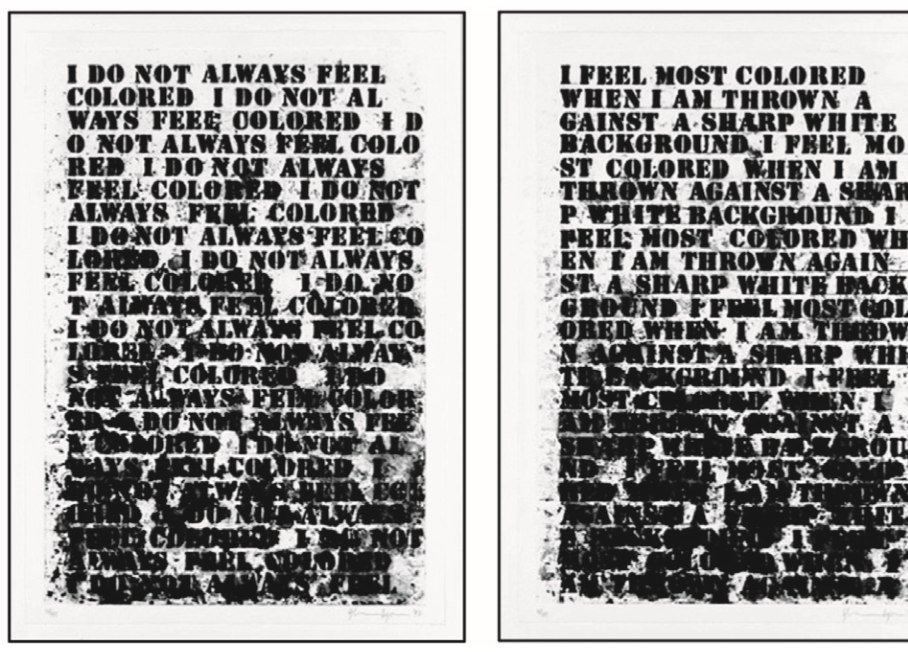
Texto 3
The artist Glenn Ligon has stenciled the sentences over and over until the words dissolve into abstract patterns. He built on a text by Zora Neale Hurston, who describes leaving the protective black community of her childhood and suddenly confronting the issue of race. The smearing in the painting’s illegible words embody her confusion about this, something Ligon builds on: “Oil paint wants to spread out and smudge. After trying to make perfect letters, I realized that the smudging and disappearance of the letters was more interesting than trying to make perfect letters.”
(Adaptado de whitney.org/media/720. Acesso em 29/04/2025.)
De acordo com o texto 3, é correto afirmar que
Explicação: O texto 3 diz que a tinta a óleo naturalmente se espalha e borra, e que Ligon passou a valorizar esse efeito, que dá corpo à confusão de Zora Neale Hurston ao enfrentar a questão racial. Portanto os borrões vêm da técnica e remetem à experiência da autora, não à identidade do artista. As alternativas (a) e (c) invertem o texto 1: Hurston diz sentir-se “mais negra” diante de um fundo branco, e não que haja invisibilização ou recusa.