Images of plants painted on pottery made up to 8,000 years ago may be the earliest example of humans’ mathematical thought, a study has found.
Researchers from the Hebrew University of Jerusalem examined pottery produced by the Halafian people of northern Mesopotamia, who lived between 6200 BC and 5500 BC.
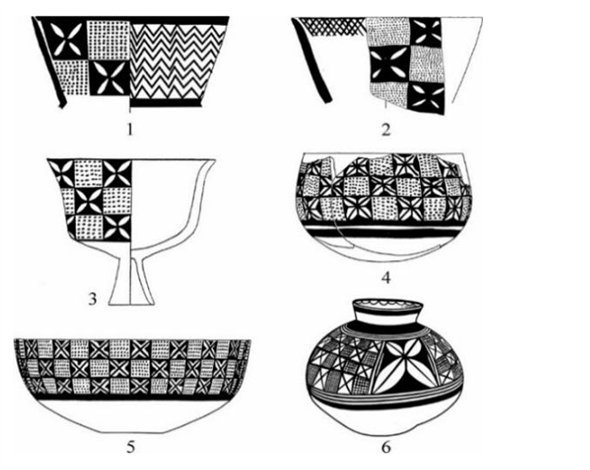
Many bowls featured flowers that have been depicted with four, eight, 16, 32 or 64 petals. The use of these numbers forms a “geometric sequence” that implies a form of mathematical reasoning rooted in symmetry and repetition, the researchers said in the study published in the Journal of World Prehistory.
The researchers examined pottery fragments from 29 Halafian sites, excavated over a 100-year period from 1899. They found that in nearly every one of the 375 fragments that depict flowers, the number of petals is determined by this doubling sequence, which divides a circle into symmetrical units.
The Halafians may have developed this form of mathematical reasoning in response to managing village communities that had existed in the Near East for some 4,000 years and had become economically complex, the researchers said.
The ability to divide space evenly, reflected in these floral motifs, likely had practical roots in daily life, such as sharing harvests or allocating communal fields.
The researchers said the Halafian use of the numbers four, eight, 16 and 32 may reflect an earlier and simpler level of mathematical thinking that was in use in the Near East in the 6th and 5th millennia BC.
According to the researchers, these patterns show that mathematical thinking began long before writing.
CNN.com. 16 January 2026 (Adaptado).
No texto, a articulação entre os fragmentos de cerâmica e a hipótese de pesquisa apresentada evidencia um procedimento metodológico que
Explicação: Os pesquisadores analisaram 375 fragmentos de cerâmica de 29 sítios e, a partir da regularidade no número de pétalas, inferiram que os halafianos tinham uma forma de raciocínio matemático. É um procedimento em que vestígios materiais servem de base a inferências sobre o pensamento antigo. O texto fala em indícios (“may”, “likely”) e não em sistema pleno de notação (B, E), nem em especulação sem dados (A) ou em mera função estética (C).